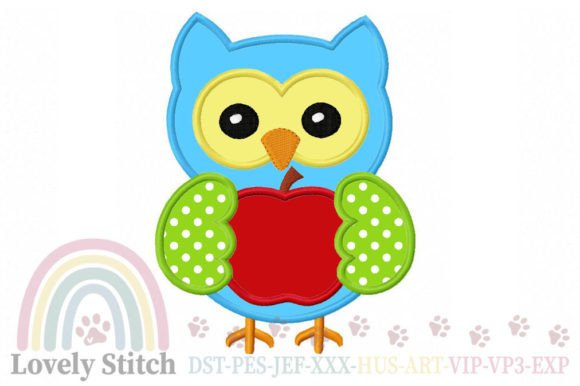
Owl Apple Embroidery Design
A Thoughtful First Impression for Brand-Forward Businesses
As an embroidery designer who’s developed and vetted hundreds of machine embroidery designs for small business merch, my first impression of the Owl Apple Embroidery Design is immediate and promising: it reads as friendly yet intentional, playful without sacrificing polish. The pairing of owl and apple taps into timeless associations—wisdom, curiosity, growth, and approachability—making it unusually versatile for businesses that want to signal warmth and credibility at once. It’s not overly cutesy, nor is it stiff or academic. That balance is rare—and valuable—for brands like indie bookshops, creative studios, holistic wellness practices, or even a neighborhood bakery that leans into “thoughtful ingredients” or “slow learning” as part of their story.
Where This Design Shines in Real Business Applications
The Owl Apple Embroidery Design excels where many whimsical motifs falter: on functional, high-touch merchandise. I’ve tested similar concepts across dozens of commercial embroidery projects—and this one stands out for its adaptability across contexts:
- Embroidered patches: Clean outlines and moderate detail allow crisp reproduction at 2.5"–3.5", especially when paired with a satin-stitched border. Perfect for sew-on or iron-on application on tote bags, denim jackets, or staff aprons.
- Staff uniforms & aprons: Its centered composition and balanced weight make it ideal for left-chest placement—professional enough for front-of-house roles, but distinctive enough to spark conversation (a subtle brand differentiator).
- Cap embroidery: Works well on structured front panels if scaled appropriately (no smaller than 2"). Avoid curved back panels unless digitized with stretch compensation—always confirm the embroidery file includes cap-ready versions.
- Tote bag design & boutique merchandise: On natural canvas or linen, the design reads as intentionally handmade—not mass-produced—enhancing perceived value for craft-based retailers and Etsy sellers.
- Product packaging accents & customer gifts: Think embroidered tags on gift boxes, mini patches on reusable produce bags, or stitched labels on ceramic mugs. Here, the Owl Apple Embroidery Design reinforces brand identity without overwhelming the product.
Smart Placement Considerations for Long-Term Wear & Recognition
While versatile, this design isn’t universally forgiving. Use caution in these scenarios:
- Small patch sizes under 2": Fine details—like apple stem texture or owl feather layering—may blur or vanish. Always request or run a test stitch-out at your target size before bulk production.
- Curved surfaces (e.g., baseball caps, contoured tote handles): Requires proper underlay and tension calibration. If the original embroidery file doesn’t specify cap-ready digitizing, consult your digitizer before stitching.
- Dark or textured fabric: High stitch density in the apple core or owl eyes may recede on heavy twill or fleece. Test thread colors—especially metallic or pastel options—against your base fabric; contrast is non-negotiable for legibility.
- Frequent washing or abrasion: Avoid placing the design on high-friction zones (e.g., lower back of work shirts) unless stabilized with cutaway + tear-away combo and high-quality polyester thread.
How Owl Apple Embroidery Design Strengthens Brand Identity
This isn’t just decoration—it’s a quiet brand amplifier. For small businesses, consistency is trust. When customers see the same thoughtful motif across your staff aprons, your reusable tote bags, and your seasonal product labels, recognition builds organically. The Owl Apple Embroidery Design supports that continuity because it’s neither trend-dependent nor overly literal. It avoids cliché while still feeling familiar—a hallmark of strong design assets. In customer-facing settings (like a café counter or pop-up market booth), it invites engagement: “Is that your logo? What’s the story behind it?” That moment of connection is worth more than any tagline.
For handmade brands and Etsy sellers, it signals craftsmanship without demanding perfectionism—it feels human-scaled, not algorithmic. And for Back To School–adjacent businesses (tutoring collectives, stationery shops, educational toy makers), it subtly aligns with learning values—without leaning into tired tropes like graduation caps or chalkboards.
Practical Embroidery Designer Notes Before You Stitch
Before committing to production, here’s what I always do—and recommend you do—with the Owl Apple Embroidery Design:
- Test in black and white first: Remove color assumptions. Does the shape hold? Are negative spaces readable? Is there enough separation between owl and apple elements?
- Check small-size viability: Resize to your smallest intended use (e.g., 1.75" for sleeve patches) and inspect stitch paths. Look for tiny jump stitches or over-dense fills that’ll pucker.
- Review thread color contrast: Especially on dark uniforms or natural fabrics. A soft sage green apple may disappear on olive canvas—swap to kelly green or navy for clarity.
- Inspect spacing and underlay: Crowded lettering or tight curves can cause thread breaks. Confirm the embroidery file includes appropriate underlay for stability on lightweight fabrics.
- Confirm hoop size and stabilizer needs: Some versions may require larger hoops (e.g., 5"x7")—verify compatibility with your machines before ordering.
- Test on real fabric: Run a sample on your exact apron twill or cap material—not just a scrap of muslin.
- Create a printable mockup for client approval: Show how it looks scaled and positioned on actual garments—not just isolated on white.
- Compare beside existing design assets: Does it harmonize with your current logo, typography, or color palette—or does it clash tonally?
- Verify commercial licensing: Since this is intended for small business merch and branded patch use, ensure the digital embroidery file grants rights for resale, promotional distribution, and client-facing embroidery services.
Remember: the most charming embroidery file only delivers value when it performs reliably across real-world conditions. The Owl Apple Embroidery Design has strong potential—but like any custom apparel element, its success hinges on intentional testing, context-aware scaling, and alignment with your brand’s voice and values.