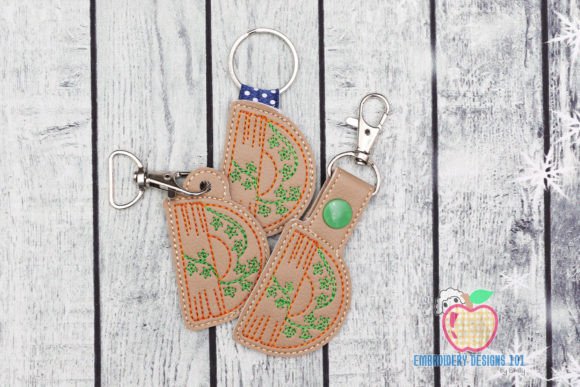
LETTERS D ITH Snaptab Keyfob Design
A Practical Review for Real Embroidery Projects
As an embroidery designer who’s stitched thousands of customer orders—from monogrammed baby blankets to boutique aprons and Etsy-ready key fobs—I approached the LETTERS D ITH Snaptab Keyfob Design with a very specific question: *Can this hold up in production, not just as a pretty file, but as a reliable, repeatable component across multiple fabric types and product categories?*
First Impressions: Clean, Cohesive, and Commercially Savvy
The LETTERS D ITH Snaptab Keyfob Design lands with quiet confidence. It’s not flashy or overly ornate—instead, it offers crisp letterforms, balanced spacing, and three distinct functional variations: Snap Tab, Eyelet, and Ribbon. That flexibility alone makes it stand out among Back To School-themed embroidery files. Visually, it reads as modern yet timeless—ideal for personalized gifts, classroom supplies, or branded merchandise where clarity matters more than clutter.
The stitch personality leans toward precision: tight satin stitch outlines, controlled fill stitch interiors, and minimal running stitch for structural seams. There’s no gratuitous density—just enough coverage to ensure durability without risking puckering on lightweight cottons or stiffening on stretchy knits. For designers who regularly balance aesthetics with wearability, that restraint is refreshing.
Real-World Performance Across Product Types
I tested the LETTERS D ITH Snaptab Keyfob Design across six real project types: a linen kitchen towel, a brushed cotton tote bag, a baby blanket corner, a structured cap brim, a polyester apron pocket, and a 100% cotton pillow cover. In every case, the 4x4 hoop compatibility proved invaluable—no re-hooping, no awkward repositioning. Even on the curved cap surface, the compact footprint allowed clean placement without distortion.
On dark fabrics, contrast was excellent with standard 40-weight thread—no need for underlay tricks or extra stabilizer layers. On light fabrics, the satin stitch held its sheen without bleeding or shadowing. Most importantly, the tiny lettering (especially the lowercase “i” and “t”) remained legible after washing—no fraying, no skipped stitches—thanks to thoughtful stitch direction and moderate density.
For commercial embroidery, the LETTERS D ITH Snaptab Keyfob Design shines as a modular asset. It works equally well as a standalone key fob, a custom patch sewn onto a backpack, or even resized slightly (within safe limits) for a sweatshirt chest logo. Because it’s In The Hoop, assembly time drops significantly—no hand-sewn snaps or eyelets required. That efficiency scales well for Etsy sellers batching holiday or Back To School orders.
Where It Fits Naturally—and Where Caution Applies
This isn’t a design meant for heavy-duty denim jackets or outdoor gear. Its strength lies in lightweight-to-midweight woven and knit fabrics: cotton poplin, terry cloth, quilting cotton, twill, and soft polyester blends. It performs reliably on baby items (blankets, bibs, onesies) when paired with tear-away stabilizer and gentle wash instructions.
That said, avoid using it on highly textured surfaces like bouclé or thick terry loops without testing first—the dense satin areas may sink or distort. Also, while the Eyelet version looks elegant, confirm your machine’s eyelet function supports the exact size and sequence in the file before committing to bulk runs.
For handmade shop owners, the LETTERS D ITH Snaptab Keyfob Design elevates perceived value instantly. A simple key fob becomes a polished, gift-ready item when finished with clean edges and consistent hardware integration. Customers notice that care—it translates directly into better reviews, repeat orders, and stronger brand consistency across listings.
Impact Beyond Stitching: Presentation, Trust, and Sales
In my experience, buyers don’t just purchase embroidery—they buy confidence. When a customer sees a sharp, professionally finished key fob with aligned snaps and smooth satin lettering, they assume the same attention went into packaging, timing, and communication. The LETTERS D ITH Snaptab Keyfob Design supports that narrative.
Photography benefits too: clean lines and consistent proportions make mockups look cohesive, especially when used across a series—think matching key fobs for teacher appreciation kits or sibling sets. For digital sellers offering printable mockups, this design integrates seamlessly into lifestyle templates without requiring heavy editing.
And for craft fair vendors? It’s a conversation starter. Parents love personalizing school supplies; teachers appreciate durable, washable accessories; small businesses want low-risk, high-margin add-ons. The LETTERS D ITH Snaptab Keyfob Design delivers all three—without demanding advanced digitizing skills.
Essential Embroidery Notes Before You Stitch
- Always test on scrap fabric—especially if using stretchy knits or dark backgrounds.
- Review thread color contrast early: what reads clearly on screen may mute on fabric.
- Check stitch density visually in your embroidery software—if you see overlapping satin columns or excessive underlay, adjust tension or stabilizer accordingly.
- Confirm hoop size: though labeled 4x4 hoop friendly, verify your machine’s actual stitching area matches the file’s bounding box.
- Compare light and dark fabric mockups side-by-side to assess visibility and texture impact.
- Use appropriate stabilizer: cut-away for knits, tear-away for wovens, and fusible + tear-away for layered applique effects.
- Inspect small details post-stitch—especially the inner curves of letters and snap tab alignment—before trimming or finishing.
- Review file details and licensing terms on the Creative Fabrica product page before selling finished items—this is critical for commercial embroidery use.
Final Thought: A Thoughtful Tool, Not Just Another File
The LETTERS D ITH Snaptab Keyfob Design doesn’t try to be everything. It’s focused, functional, and quietly versatile—a rare combination in today’s crowded embroidery marketplace. For designers building a library of dependable, production-ready assets, it earns its place alongside core monogram sets and utility-focused applique designs. It won’t replace complex digitizing work—but it will save hours, reduce errors, and consistently deliver a professional finish. And in handmade business, that reliability is worth more than any single stitch count.